
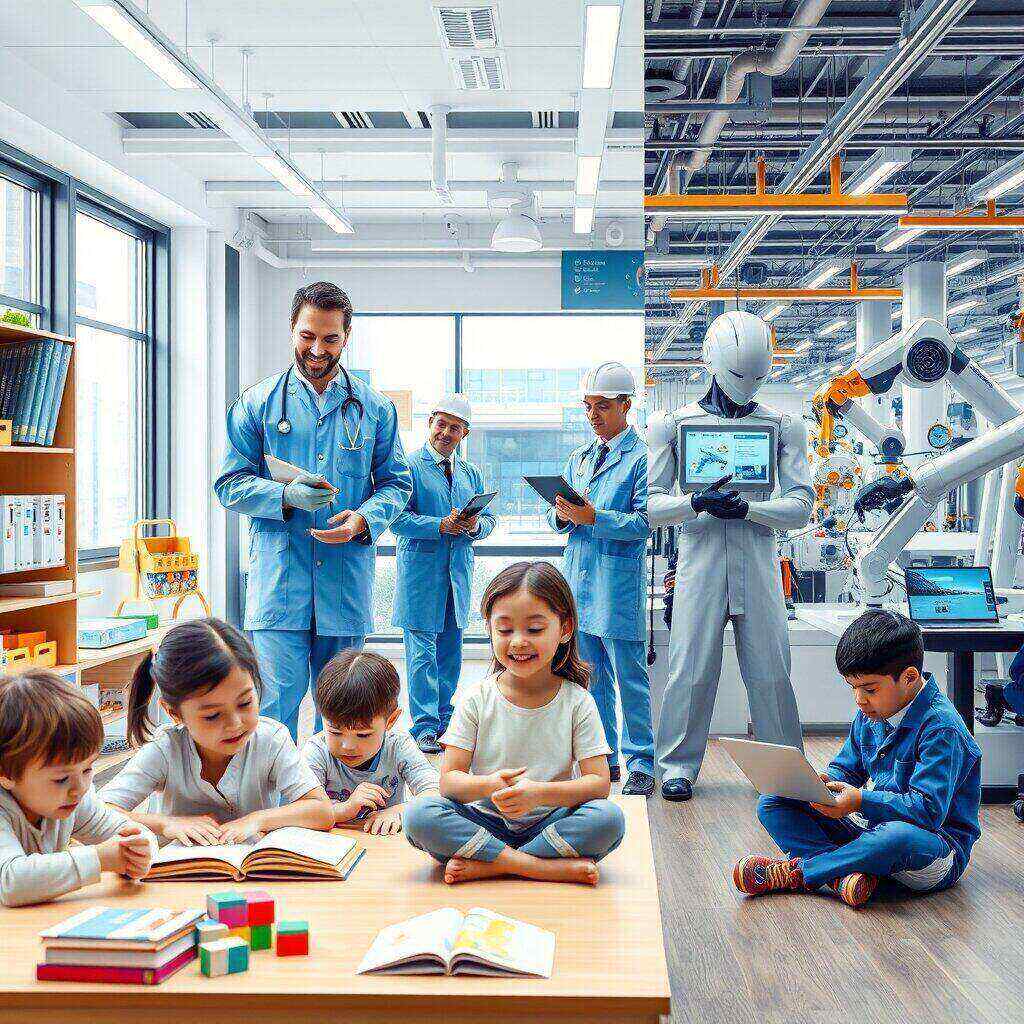
US pre-K investment, stable healthcare staffing in Norway, and rapid growth in industrial data systems reveal where governments and employers are placing their bets. The bigger story is clear: stronger foundations, smarter skills, and more connected infrastructure. #education #prek #healthcareworkforce #aiskills #dataintegration #industry40
Across education, healthcare, and industry, 2025 is being shaped by a common priority: building systems that are more prepared for long-term change. On the surface, rising pre-K funding in the United States, a steady healthcare workforce in Norway, and booming demand for data storage and integration in manufacturing may seem like separate developments. In reality, they point to the same shift in strategy.
Governments, schools, and employers are investing less in short-term fixes and more in strong foundations. That means earlier educational support, better workforce planning, and digital infrastructure capable of handling modern demands. It also means that students, graduates, and early-career professionals need to think more broadly about what employability looks like now. Technical skills matter, but so do adaptability, systems thinking, and the ability to work across disciplines.
Several recent developments underline this trend. Saudi Arabia has approved Kingdom University in Riyadh in partnership with international universities, signaling a stronger push toward globally connected higher education. Pearson and Salesforce are expanding their partnership around workforce AI training, showing how quickly artificial intelligence is becoming part of mainstream skills development. Microsoft is also rolling out an AI-focused initiative for schools in Australia, bringing digital fluency into earlier stages of learning.
Taken together, these moves show that the future of work is no longer being addressed only at the university or corporate level. It is being shaped from preschool through professional reskilling, and increasingly supported by the data systems that keep modern organizations running.
Why rising US pre-K funding matters far beyond early childhood
State-funded pre-K programs in the United States expanded in 2024, continuing a broader movement toward stronger early childhood education. This is not simply a policy story about school budgets. It is a recognition that learning outcomes begin long before students enter formal K-12 classrooms.
For years, research has linked quality early childhood education with better school readiness, stronger literacy and numeracy foundations, improved social development, and even better long-term economic outcomes. When states expand pre-K access, they are not just funding childcare. They are investing in the future academic pipeline and, indirectly, the future workforce.
A key part of this momentum comes from federal support mechanisms such as the Preschool Development Grants Birth through Five program, which helps states strengthen access, improve quality, and coordinate early learning systems more effectively.
What is driving the increase in funding?
- School readiness: Children entering kindergarten with stronger foundational skills are more likely to succeed throughout their education.
- Workforce participation: Access to affordable pre-K also supports parents and caregivers who need reliable learning environments for young children.
- Equity goals: Early investment can help reduce educational gaps before they widen in later years.
- Long-term returns: Policymakers increasingly view early childhood education as infrastructure, not an optional add-on.
For students and families, this matters because educational inequality often starts early. For educators, it highlights the growing importance of early learning quality, teacher training, and curriculum design. For the labor market, it reinforces a simple reality: talent pipelines do not begin at graduation. They begin much earlier.
As countries compete for innovation capacity, the ability to support learning from the beginning is becoming a strategic advantage.
AI and workforce development are moving into mainstream education
If pre-K funding shows the value of early foundations, the recent moves by Pearson, Salesforce, and Microsoft show how those foundations are being updated for a digital era. AI literacy is no longer treated as a niche skill reserved for developers or data scientists. It is quickly becoming part of general career readiness.
Pearson and Salesforce expanding their partnership around workforce AI training reflects a growing demand for practical, job-relevant digital skills. Employers are not only looking for people who can use AI tools. They want professionals who understand where AI adds value, where it creates risk, and how it fits into business workflows, customer operations, learning systems, and decision-making.
Microsoft’s AI initiative for Australian schools sends a similar message from a different angle. Digital skills development is starting earlier, and schools are being asked to prepare students for a world where AI sits alongside writing, research, collaboration, and problem-solving.
What AI readiness now includes
AI readiness is broader than coding. In many education and workplace settings, it now includes:
- Prompting and interacting effectively with AI systems
- Understanding data quality and bias
- Using AI for research, productivity, and creativity
- Knowing privacy, ethics, and responsible use standards
- Interpreting AI-generated outputs with human judgment
This shift creates new opportunities for learners who may not come from traditional computer science backgrounds. Students in business, healthcare, education, and design can all benefit from AI fluency. Those looking to build applied skills can explore structured programs in AI and machine learning to understand how these tools move from theory into practical projects.
The broader lesson is that employability is becoming more layered. Basic digital literacy is no longer enough. The next step is tool fluency, analytical thinking, and the ability to work with intelligent systems without becoming dependent on them.
Saudi Arabia’s new university move reflects the global education race
Saudi Arabia’s approval of Kingdom University in Riyadh, in partnership with international universities, is another sign of how education systems are repositioning themselves. Around the world, countries are trying to attract talent, strengthen research capacity, and make higher education more globally connected.
International partnerships in higher education do more than raise institutional visibility. They can expand curriculum quality, increase access to specialized programs, improve research collaboration, and expose students to more global standards in teaching and employability.
For students, that matters because location is becoming less of a limit. More universities are blending local relevance with international partnerships, which can improve access to modern programs in technology, business, health sciences, and innovation. For policymakers, these partnerships are part of a larger economic strategy tied to diversification, talent retention, and global competitiveness.
Higher education is no longer just about degree delivery. It is becoming a platform for research ecosystems, startup culture, digital skills, and industry alignment. In that environment, institutions that build strong partnerships are more likely to stay relevant.
Norway’s stable healthcare workforce offers a different kind of success story
While many countries continue to struggle with healthcare staffing shortages, Norway’s healthcare workforce has remained broadly steady, with only minor fluctuations. That may sound less dramatic than rapid growth, but in workforce planning terms, stability can be one of the strongest indicators of a healthy system.
Healthcare demand is rising almost everywhere due to aging populations, chronic disease burdens, and increased expectations for quality care. In that context, maintaining a balanced workforce is not easy. It usually depends on training capacity, retention measures, working conditions, regional planning, and sustained public investment.
Norway’s approach has been supported by long-term planning through national policy frameworks such as the country’s health system strategies managed by the Ministry of Health and Care Services. The key takeaway is not that healthcare systems should simply aim for more hiring. They need smarter hiring, better retention, and stronger alignment between training and service demand.
What workforce stability actually means
- More reliable care delivery: Patients benefit when systems are not constantly reacting to staffing gaps.
- Lower burnout pressure: Stable staffing can reduce strain on existing professionals.
- Better training outcomes: A planned pipeline improves the transition from education into healthcare roles.
- Regional resilience: Balanced staffing helps maintain services across urban and rural areas.
For students considering healthcare careers, Norway’s example shows that workforce sustainability matters as much as job demand. A profession with strong planning, clear training routes, and policy support is more likely to offer durable career paths than one driven only by emergency hiring.
It also highlights a bigger point for education leaders: workforce development is not just about producing graduates. It is about creating conditions in which trained people can stay, grow, and continue contributing over time.
Why data storage and integration now dominate manufacturing priorities
One of the most striking signals from industry is that data storage and integration now account for more than half of global manufacturing data management revenue. That figure captures something essential about modern production: factories are no longer powered only by machines. They are powered by connected information.
As manufacturers adopt sensors, automation systems, robotics, digital twins, predictive maintenance, and real-time monitoring, the amount of data generated across operations has exploded. Collecting data is no longer the difficult part. The real challenge is storing it efficiently, connecting it across platforms, and turning it into useful operational insight.
That is why storage and integration have become core revenue drivers. Manufacturers need systems that can connect shop-floor equipment with cloud platforms, enterprise software, analytics dashboards, supply chain systems, and quality control tools. Without integration, valuable industrial data stays trapped in isolated systems. Without reliable storage, historical analysis, compliance, and optimization become much harder.
What is fueling this demand?
- More connected devices across industrial environments
- Greater use of digital twins and simulation tools
- Real-time decision-making in production lines
- Stronger compliance, traceability, and cybersecurity requirements
- Pressure to reduce downtime and improve efficiency
This trend is closely aligned with Europe’s push toward data-driven industrial transformation, including initiatives connected to the European Commission’s industrial innovation agenda. The message for learners is clear: manufacturing careers are becoming deeply digital.
Students interested in this shift should pay attention to cloud platforms, databases, APIs, industrial IoT, and analytics. Practical pathways in data analytics and data science or cloud computing and DevOps can be especially relevant as factories increasingly rely on connected systems and scalable infrastructure.
What used to be seen as back-end IT work is now central to production performance. In smart manufacturing, data architecture is business architecture.
The common thread across schools, hospitals, and factories
Although these developments span very different sectors, they share a common logic. Each one is about building systems that can handle complexity without breaking under pressure.
In early education, that means investing before learning gaps widen. In healthcare, it means maintaining workforce balance rather than constantly reacting to shortages. In manufacturing, it means creating digital infrastructure that can support real-time, high-volume, high-value operations.
There is also a shared skills story underneath all three. Institutions increasingly need people who can work across boundaries: educators who understand digital tools, healthcare professionals who can navigate evolving systems, and industrial teams who can connect operational knowledge with data capabilities.
For students and graduates, this is an important shift. Career success is becoming less about narrow specialization alone and more about combining domain expertise with transferable digital and analytical skills.
What students and early-career professionals should do next
The safest strategy in a changing market is not to chase every trend. It is to build durable capabilities that stay useful across sectors.
- Strengthen your fundamentals: Communication, problem-solving, and analytical thinking still matter in every field.
- Learn the language of data: Even non-technical roles increasingly rely on dashboards, reporting, and evidence-based decisions.
- Build AI awareness: You do not need to be an AI engineer to benefit from understanding how AI tools are used responsibly.
- Follow policy signals: Funding shifts often reveal where future opportunities will grow.
- Pursue practical experience: Projects, labs, and internships help translate knowledge into employable skills.
One reason this matters is that the fastest-growing opportunities often sit between categories. A healthcare analyst, an education technology specialist, or a manufacturing data engineer may need blended skills rather than a single traditional qualification. That is also why curated learning pathways and applied internships have become more valuable for career development.
Students looking to explore career-aligned options across technology domains can also browse broader opportunities through internship programs across emerging fields, especially where technical training intersects with real workplace needs.
Why these signals matter beyond 2025
The most important takeaway from these developments is not that one sector is growing faster than another. It is that resilience is now a central design principle for education and workforce systems. Countries are investing earlier, planning more carefully, and relying more heavily on digital infrastructure to support both learning and work.
That changes how students should think about preparation. It is no longer enough to ask which industry is hiring today. A better question is which skills will remain useful as systems become more connected, more data-driven, and more dependent on long-term planning.
Early learning investment, stable healthcare staffing, global university partnerships, AI training initiatives, and industrial data platforms all point toward the same future: one where strong foundations and adaptable skills matter more than short-lived trends. The people who thrive in that environment will be the ones who can learn continuously, understand systems, and move confidently between technology and real-world needs.
#education #prek #healthcareworkforce #aiskills #dataintegration #industry40


 Views Today : 3
 Views Yesterday : 190
 Your IP Address : 216.73.216.103