
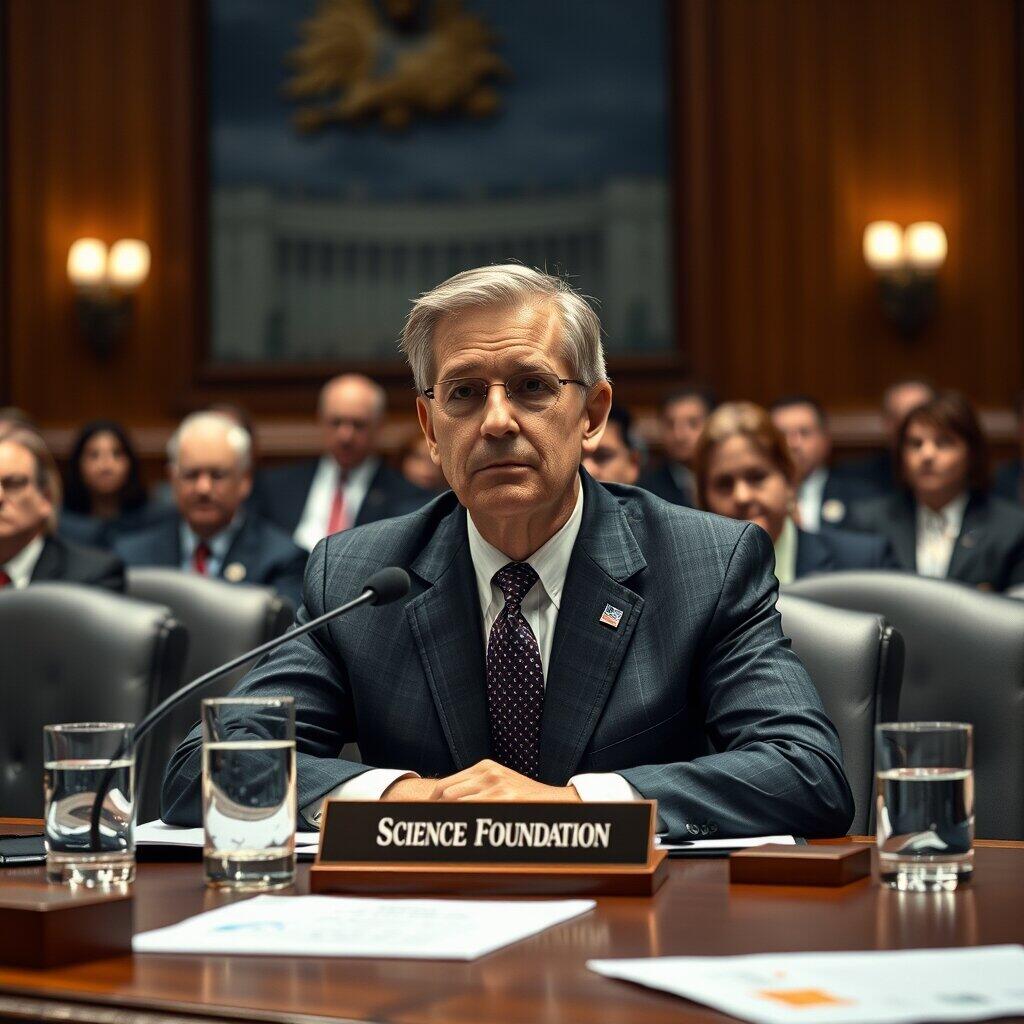
AAAS is urging a confirmation hearing for the NSF director, highlighting a leadership decision with real consequences for research funding, universities, STEM careers, and innovation policy across the United States. #nsf #sciencepolicy #researchfunding #highereducation #stemcareers #innovation
The American Association for the Advancement of Science (AAAS) calling for a confirmation hearing for the National Science Foundation (NSF) director is more than a procedural headline. It signals growing concern about how scientific leadership is handled at a moment when universities, research labs, startups, and students are all watching federal science policy closely.
For many readers outside Washington, a confirmation hearing may sound technical or distant. In reality, the leadership of the NSF touches a wide range of issues that shape academic life and the innovation economy: grant funding, graduate fellowships, campus research programs, emerging technology priorities, and the long-term health of the U.S. STEM pipeline.
When a major scientific organization like AAAS publicly pushes for a hearing, it usually reflects a broader belief that the country needs transparency, accountability, and stable leadership in one of its most important research institutions. That matters not just to policy insiders, but also to students planning research careers, faculty seeking grants, and industries that depend on foundational science.
Why the National Science Foundation holds so much influence
The NSF is one of the most important federal agencies supporting science and engineering research in the United States. Through its grants, fellowships, and strategic investments, the agency helps fund work in computer science, AI, cybersecurity, mathematics, physics, climate science, education research, and many other fields.
Unlike agencies focused mainly on applied missions, the NSF has long played a central role in backing basic research. That matters because many of today’s most transformative technologies began as ideas that did not look commercially obvious at first. Federal support helped build the foundations for internet technologies, advanced computing, data science methods, and major engineering breakthroughs.
Its influence reaches beyond laboratories. NSF priorities often shape:
- what research universities emphasize in new programs
- which interdisciplinary projects get momentum
- how graduate students and postdocs find support
- what workforce development initiatives expand nationally
- how emerging fields move from theory to real-world application
That is why leadership at the agency matters so deeply. The NSF director is not just an administrator. The position helps set tone, direction, and credibility for the nation’s scientific agenda.
What AAAS is really signaling
AAAS is one of the most visible organizations in the U.S. science community. When it calls for a confirmation hearing, the message is not simply that a seat should be filled. The deeper point is that scientific leadership deserves open public review, especially at a time when trust in institutions, public investment, and policy transparency all matter.
A Senate confirmation hearing gives lawmakers, researchers, and the public an opportunity to hear directly from a nominee. It creates a record of how that person views research independence, scientific integrity, funding priorities, education, national competitiveness, and international collaboration.
That process can be especially important when the NSF is expected to support fast-evolving areas such as artificial intelligence, semiconductor research, secure infrastructure, advanced manufacturing, and climate resilience. Each of these areas carries both economic promise and policy complexity.
In effect, AAAS appears to be making a broader argument: a research agency of this size and significance should not operate under uncertainty for long, and the country benefits when leadership decisions are discussed openly rather than treated as routine appointments.
Why a confirmation hearing matters to universities and colleges
Higher education institutions are among the most directly affected by NSF leadership decisions. Many universities depend on NSF grants to sustain faculty research, support graduate assistants, purchase equipment, and build collaborative centers across disciplines.
For large research universities, NSF funding helps anchor entire ecosystems. For smaller institutions, minority-serving institutions, and regional campuses, NSF programs can be critical for expanding access to STEM research and improving participation among students who have historically been underrepresented in science and engineering.
Leadership uncertainty can affect how confidently institutions plan ahead. Even if grant programs continue operating, universities pay attention to signals from the top: what areas are likely to receive emphasis, how education and workforce programs may evolve, and whether interdisciplinary initiatives will grow or stall.
This is particularly relevant now, as institutions try to align education with workforce demand in AI, cloud systems, cyber defense, and data-intensive fields. Students exploring practical training in areas like AI and machine learning internships or data analytics and data science internships are entering fields that depend heavily on the strength of the broader research ecosystem. Federal science leadership eventually shapes the opportunities they see in classrooms, labs, and industry partnerships.
The link between NSF leadership and student opportunity
Students often experience federal science policy indirectly. They may not follow hearings or leadership nominations, but they certainly feel the outcomes. A well-led NSF can influence the number of funded research experiences available to undergraduates, the availability of graduate fellowships, the direction of training grants, and the expansion of research infrastructure at universities.
That matters for students in several ways.
Research access
Students looking to enter academia, engineering, computing, or public-interest technology often rely on early research opportunities. If NSF-backed programs are healthy and clearly prioritized, universities are better positioned to offer hands-on experiences that strengthen academic and career pathways.
Graduate education
Many graduate students depend on research assistantships and federally supported labs. Changes in agency direction can affect which departments grow, which projects recruit students, and where doctoral candidates choose to specialize.
Workforce readiness
The NSF is also deeply connected to the future STEM workforce. Its role is not just about publishing papers; it also includes supporting talent pipelines, regional innovation efforts, and partnerships between academia and industry. Students who later move into practical technical roles, including cloud computing and DevOps training pathways, still benefit from the upstream research environment that helps create new tools, methods, and demand.
Why timing matters in 2026
The call for a confirmation hearing arrives at a time when science, technology, and industrial policy are closely connected. Federal research agencies are being asked to do more than ever: support discovery, strengthen competitiveness, accelerate commercialization, expand participation, and respond to national priorities ranging from AI governance to secure infrastructure.
That growing mission makes leadership delays more consequential. In earlier eras, some agency transitions might have seemed relatively low-profile. Today, they are tied to questions about how the United States intends to compete globally, how it will support innovation responsibly, and how it will prepare students for technology-driven careers.
NSF leadership also matters because research policy no longer lives in a silo. It now intersects with economic development, semiconductor manufacturing, national security, startup ecosystems, and digital inclusion. A director needs not only scientific credibility, but also the ability to navigate policy, communicate priorities clearly, and maintain trust across multiple constituencies.
What lawmakers typically examine in a hearing
If a confirmation hearing moves forward, senators are likely to explore more than the nominee’s résumé. The discussion may touch on how the nominee would approach several high-stakes issues:
- protecting scientific independence and evidence-based decision-making
- balancing basic research with near-term economic priorities
- supporting AI, advanced computing, and emerging technology responsibly
- strengthening research security without undermining open collaboration
- expanding access for underrepresented institutions and student groups
- improving the efficiency and fairness of grant review processes
- supporting regional innovation beyond a handful of established hubs
Those questions are not abstract. They connect directly to how research dollars are distributed, how institutions compete, and how the next generation of scientists and technologists finds support.
Science policy is also workforce policy
One reason the NSF director role deserves broader public attention is that science policy increasingly shapes labor markets. The future of AI, quantum information science, cybersecurity, biotechnology, clean energy systems, and advanced materials depends on a steady flow of well-trained talent.
That talent does not appear automatically. It is developed through schools, colleges, labs, internships, mentorship, and research funding. A strong NSF helps maintain that chain. Weak or uncertain leadership can make the system feel fragmented at exactly the time when the country is trying to scale up technical capacity.
For students and recent graduates, this is especially relevant. Many are trying to understand which skills are durable and where demand is headed. National research priorities often become early indicators. When federal agencies invest consistently in fields such as machine learning, secure computing, and scientific software, universities respond by building courses, labs, and credentials around them.
That is also why students often benefit from exploring broader career pathways, including hands-on opportunities listed through technology internship programs. Policy decisions at the top and practical skills development on the ground are more connected than they may seem.
Transparency matters in periods of institutional strain
There is another reason AAAS’s position stands out: confirmation hearings serve a public trust function. At a time when many institutions face skepticism, visible review processes can help reinforce legitimacy.
Research agencies operate best when scientists, students, universities, lawmakers, and taxpayers understand who is leading them and what principles guide their decisions. A hearing gives the nominee the chance to explain priorities, answer concerns, and demonstrate readiness for a role that affects billions of dollars in public investment.
It also gives the broader scientific community a clearer sense of what to expect. That clarity can be stabilizing, especially in periods marked by budget pressure, political tension, or rapid shifts in technology policy.
The broader message to the research community
For faculty members, lab leaders, graduate students, and administrators, AAAS’s call can also be read as a reminder that science governance should not be treated as invisible background machinery. Leadership choices shape institutional confidence. They influence whether researchers feel federal systems are stable, fair, and aligned with long-term national needs.
That message may resonate strongly with early-career researchers, who are often the most vulnerable to uncertainty. A principal investigator with an established lab may be able to absorb delays or shifting signals more easily than a first-year doctoral student, postdoctoral scholar, or newly hired assistant professor.
In that sense, confirmation is not just about symbolic oversight. It is about how the research ecosystem communicates seriousness to those building careers inside it.
Where readers can track the issue
Readers who want to understand the institutional context can follow the National Science Foundation for official information on agency priorities and funding programs, and the American Association for the Advancement of Science for updates on science policy advocacy and research community perspectives.
For students, these organizations are useful not only as news sources but also as windows into how science policy affects education, funding, and future careers.
Why this moment deserves attention beyond Washington
It is easy to treat a confirmation hearing as an inside-the-Beltway matter. But the question of who leads the NSF reaches into classrooms, research centers, startup incubators, and regional innovation corridors across the country. It affects whether institutions can plan confidently, whether students can see stable pathways into research, and whether public investment in science feels strategic rather than reactive.
AAAS calling for a hearing underscores an important principle: leadership in science is too consequential to remain opaque or delayed. The nation’s research agenda depends not only on funding levels, but also on trusted governance, public accountability, and a clear sense of direction.
For universities, that means greater stability in planning and investment. For students, it can mean stronger access to research opportunities and better alignment between education and the future of work. For the wider public, it means a better chance that the institutions shaping tomorrow’s technologies are being led with transparency and purpose.
As debates continue around innovation, competitiveness, and the future of higher education, this is one of those policy moments that deserves more attention than it may initially receive. Decisions about scientific leadership often look procedural on the surface. In practice, they help determine how seriously a country treats discovery, talent, and long-term progress.
#nsf #sciencepolicy #researchfunding #highereducation #stemcareers #innovation


 Views Today : 137
 Views Yesterday : 268
 Your IP Address : 217.76.57.9