
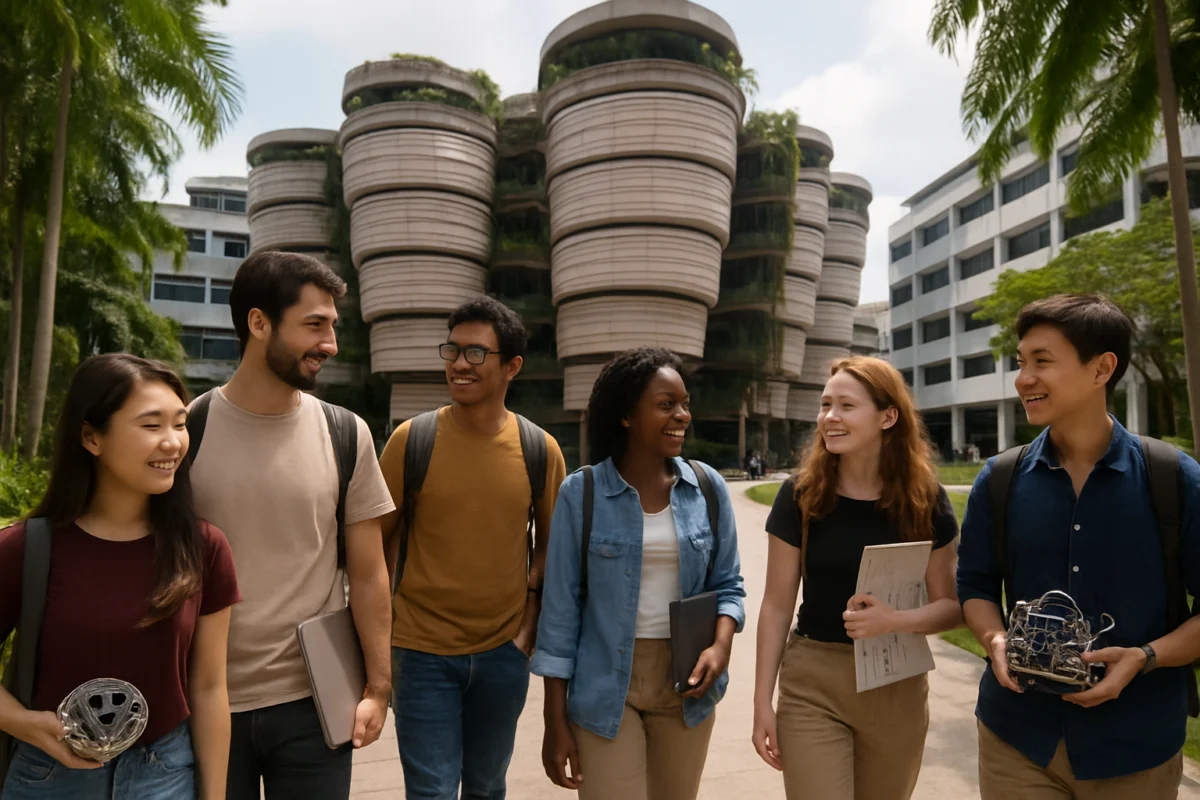
Nanyang Technological University, usually called NTU, is one of those universities that immediately feels built for the future. For students interested in engineering, computing, innovation, and applied technology, it offers a mix that is hard to ignore: strong academic reputation, modern infrastructure, deep industry links, and a campus culture that feels active rather than purely classroom-based. Located in Singapore, NTU also attracts a large international student population, so the experience is not just about lectures and labs. It is also about adapting to a fast-moving academic system, living in one of Asia’s safest cities, and learning how to work with people from very different educational backgrounds.
What makes NTU especially attractive for international students is that it does not feel isolated from the real world. The university’s engineering and technology ecosystem is closely tied to research, enterprise, startups, and career preparation. At the same time, student life is not overly formal. There is hall culture, club activity, late-night project work, campus food courts, multicultural friendships, and the everyday rhythm of living in tropical Singapore.
Quick facts students usually want first
- Location: Jurong West, Singapore
- Known for: Engineering, computer science, business, materials science, communication, and research
- Teaching style: Lecture plus tutorial plus lab, with a strong project and assessment component
- Main undergraduate intake: Usually August
- Academic calendar: Two main semesters, with a special term in summer
- Student profile: Strong mix of local and international students from Asia and beyond
- Career advantage: Strong employer visibility in Singapore’s technology, manufacturing, consulting, finance, and research sectors
Campus atmosphere: modern, green, and surprisingly self-contained
One of the first things students notice about NTU is that the campus is huge by Singapore standards. It is not a compact city campus where you walk five minutes between every building. Instead, it feels like a self-contained academic town with residence halls, research buildings, libraries, sports facilities, food outlets, maker spaces, and large teaching blocks spread across a green landscape.
The campus environment matters more than many applicants expect. NTU has a polished, modern feel, but it is not cold or corporate. You see students moving between engineering labs, design studios, and seminar spaces, but you also see people sitting outside with bubble tea, cycling across campus, or discussing a group project in one of the open study areas. The famous Learning Hub, often called The Hive, reflects this atmosphere well: collaborative, open, and designed for discussion rather than passive note-taking.
For international students, this kind of campus is often reassuring. The transition into university life can feel smoother when housing, dining, study spaces, and social activity are all closely connected. NTU’s residential hall culture adds to that. Many students form their first serious friendships through hall events, shared meals, club activities, and everyday academic survival.
What the surrounding city adds
Singapore itself is a major part of the NTU experience. It is efficient, safe, multicultural, and globally connected. That is excellent for international students, especially those studying technology and engineering, because the city-state is deeply linked to sectors like semiconductors, advanced manufacturing, AI, fintech, logistics, and smart infrastructure. Even outside the classroom, students are surrounded by examples of how technology is applied in public systems and business.
The only trade-off is that Singapore is not cheap by regional standards. It is more manageable than some Western study destinations in certain areas, but it is still a high-cost city. Students who budget well, use campus dining, live in university accommodation, and rely on public transport usually handle costs better than expected.
Academic environment: rigorous, structured, and fast-moving
NTU is not a place where students can coast through the semester and suddenly study before finals. The academic culture is structured and demanding. In many engineering and technology programs, you are balancing lectures, tutorial sheets, laboratory sessions, quizzes, coding work, presentations, and group assignments at the same time. The pace can feel intense, especially for students coming from school systems where independent learning was less emphasized.
Professors and teaching staff generally expect students to take responsibility for their own progress. This does not mean there is no support, but it does mean that deadlines matter, weekly preparation matters, and group participation matters. Students often learn quickly that understanding the content is only one part of success. Time management, communication, and consistency are equally important.
Semester system and exam timeline
NTU usually follows a two-semester academic structure:
- Semester 1: Typically starts in August and runs through November, with examinations usually in late November to early December
- Semester 2: Usually runs from January to April, with exams in late April to early May
- Special Term: May to July for selected modules, short courses, or academic flexibility
Within each semester, students can expect a steady rhythm of academic pressure. Weeks 1 to 4 are often manageable, but by the middle of term the workload builds quickly. Midterm quizzes, lab submissions, project checkpoints, and team presentations often cluster around the same period. Final assessments may include both written examinations and practical or design-based submissions, depending on the course.
Engineering students especially should expect weeks where lab work and theory overlap heavily. It is common to have coding tasks, simulation exercises, or prototype testing going on at the same time as regular coursework.
Popular technology and engineering programs
NTU’s strongest reputation internationally is closely tied to engineering and technology. Students often consider the university for programs that balance theory with practical application and future industry relevance.
- Computer Science
- Computer Engineering
- Electrical and Electronic Engineering
- Mechanical Engineering
- Aerospace Engineering
- Civil Engineering
- Materials Science and Engineering
- Data Science and Artificial Intelligence related pathways
- Information engineering and interdisciplinary tech programs
What stands out is that many of these programs are not taught in a narrow textbook style. Students work through design tasks, coding assignments, hardware integration, labs, case-based problem solving, and final-year projects that push them to connect concepts with actual systems. Someone exploring AI & machine learning programs or data-driven engineering pathways will usually find NTU’s ecosystem well aligned with current industry interests.
Practical learning culture: this is where NTU feels strongest
Many universities say they are practical. NTU usually demonstrates it more clearly than most. In engineering and technology courses, practical learning is not treated as an add-on. It is embedded into the way students move through modules. Labs are important, but so are prototypes, simulations, presentations, capstone projects, and team-based problem solving.
Students are regularly pushed to build things, test assumptions, and defend design decisions. In some programs, that may mean software systems. In others, it may mean circuit design, robotics, material testing, or systems integration. Those interested in hardware and prototyping often benefit from exposure similar to embedded systems projects, where the learning process depends on iteration rather than memorization.
Project-based learning also has a social side. You learn very quickly how group work operates when deadlines are close and everyone has different strengths. Some students become good at technical design, others at project coordination, others at documentation and presentation. That workflow is useful later because it mirrors the way industry teams actually function.
Innovation and startup mindset
NTU has a noticeable innovation culture. This comes not only from formal research but also from entrepreneurship support, competition culture, and interdisciplinary collaboration. Students with startup ambitions often find the environment encouraging because Singapore’s wider ecosystem includes incubators, venture activity, corporate innovation teams, and public support for tech enterprise.
Within the university, students are exposed to innovation through hackathons, design challenges, research commercialization conversations, and entrepreneurial communities. NTU’s enterprise-focused ecosystem does not mean everyone becomes a founder, but it does mean students are often encouraged to think beyond grades. Can an idea become a product? Can a research project become a useful tool? Can a student team build something worth showcasing?
That mindset is particularly valuable for students in software, electronics, automation, and systems engineering. Those building modern technical profiles often pair their degree learning with extra development in areas like cloud computing skills, deployment workflows, or technical portfolio building.
What international students usually notice first
International students at NTU often describe the experience as both exciting and disciplined. The multicultural setting is real, not cosmetic. You meet classmates from Singapore, China, Southeast Asia, the Middle East, Europe, and other regions, and this shapes both classroom discussions and everyday social life.
At the same time, there is a strong sense of order. Administrative systems are generally efficient, deadlines are firm, attendance expectations may matter depending on the course, and the university expects students to manage themselves responsibly. For many students, that structure feels helpful. For others, it takes time to adjust.
Student lifestyle and daily rhythm
A typical day can be a blend of lectures, lab sessions, meals at campus canteens, library work, and evening project meetings. During quieter weeks, there is time for student clubs, sports, performances, networking events, or simply exploring the city. During heavy weeks, university life can become very assignment-centered.
Hall life can make a major difference. Students living on campus usually find it easier to join activities, access facilities late, and build a stronger social network. It also reduces commuting time, which becomes important during project-heavy periods.
- Campus food is varied and relatively student-friendly for Singapore
- Public transport is reliable, though campus travel itself can take time
- Clubs and societies help international students settle faster
- Singapore’s safety and cleanliness are big positives for first-time overseas students
Admissions structure: competitive but clear
Admission to NTU is competitive, especially in high-demand technology and engineering programs. For undergraduate entry, most students join in the August intake. Application windows vary by qualification type, but they often open months in advance, commonly from late one year into the early part of the next. International applicants should always check the official undergraduate admissions page for the latest deadlines and document requirements.
Applicants are typically assessed based on academic performance in recognized school qualifications such as A Levels, IB, national high school systems, or equivalent credentials. Competitive programs may expect strong mathematics and science preparation. English language requirements apply where relevant, and some programs may request additional supporting information.
Graduate admissions are more program-specific. Some master’s programs have one main intake, while others may have different timelines. Research-focused pathways place more emphasis on academic alignment, proposal strength, and faculty interests.
What students should prepare beyond grades
Good scores matter, but students entering NTU’s engineering and computing environment benefit from more than academics alone. It helps to arrive with some comfort in self-study, digital tools, technical writing, and collaborative work. Even basic familiarity with coding, problem-solving platforms, or small technical projects can make the first semester less overwhelming.
Students can explore the broader university environment through the official NTU website, which is useful for understanding schools, facilities, and student life before applying.
Career pathways and placement reality
Students from South Asia often ask about placements, and it is worth understanding that the Singapore model does not work exactly like a centralized mass-placement system seen elsewhere. At NTU, career outcomes are generally strong, but the process is more employer-driven and student-driven. Companies recruit through career fairs, networking sessions, online applications, internship pathways, faculty links, and graduate hiring cycles.
This actually suits proactive students well. NTU students in engineering and tech often build employability through several layers at once: coursework, technical projects, hackathons, research exposure, internships, portfolio work, and career center support. Resume quality matters. Communication matters. So does evidence that you can apply what you learned.
Common sectors NTU students move into
- Software engineering and product development
- Semiconductor and electronics industries
- Robotics and automation
- Data and analytics roles
- Cybersecurity and systems engineering
- Consulting and operations technology
- Research labs and graduate study
- Fintech and digital business roles
Students who prepare early tend to do better. That means joining projects, refining technical portfolios, learning how to present work clearly, and understanding hiring timelines. Final-year students often become more intentional about role targeting, skill gaps, and industry expectations.
Affordability: better framed as value, not cheapness
NTU is not the kind of university you would call cheap in an absolute sense, mainly because Singapore itself is expensive. Still, many students see it as strong value for money when compared with universities in cities like London, Sydney, or parts of the United States. The university’s global reputation, employer visibility, research strength, and structured campus life make the cost easier to justify for many international students.
Accommodation and food costs vary depending on whether you secure campus housing and how you manage your lifestyle. Campus dining and public transport help keep day-to-day spending under control. Scholarships, grants, and subsidized tuition routes can also change the cost picture significantly, so applicants should review the latest fee and funding policies carefully.
Common challenges students should be honest about
NTU is impressive, but it is not effortless. The first major challenge is workload. Technology and engineering students can feel stretched by overlapping deadlines, lab commitments, and exam preparation. The second is competition. You are surrounded by capable, motivated students, and that can be inspiring or intimidating depending on your mindset.
Another common adjustment issue is group work across cultures. It is valuable, but it can also be frustrating when expectations about communication, punctuality, or quality differ. International students may also need time to adapt to Singapore’s climate, local pace, and the practical realities of budgeting in an expensive city.
None of these issues are unusual, but they do shape the real student experience. The students who thrive most at NTU are usually those who stay organized, ask for help early, and treat university as a full learning environment rather than just a place to attend classes.
So, who is NTU really a good fit for?
NTU works especially well for students who want a serious academic environment without losing access to modern campus life, multicultural exposure, and strong industry relevance. It is a very good fit for those interested in engineering, computing, research-led innovation, and practical problem solving. It also suits students who like working on projects, joining technical communities, and building a career profile step by step rather than depending only on exam scores.
For international students, the overall experience can be demanding but deeply rewarding. You are not just earning a degree. You are learning how to function in a high-performance academic culture, how to work across disciplines and backgrounds, and how to prepare for a global technology job market in a city that takes innovation seriously. If that is the kind of university journey you want, NTU is one of the strongest options in Southeast Asia to consider carefully.


 Views Today : 166
 Views Yesterday : 253
 Your IP Address : 217.76.57.9