
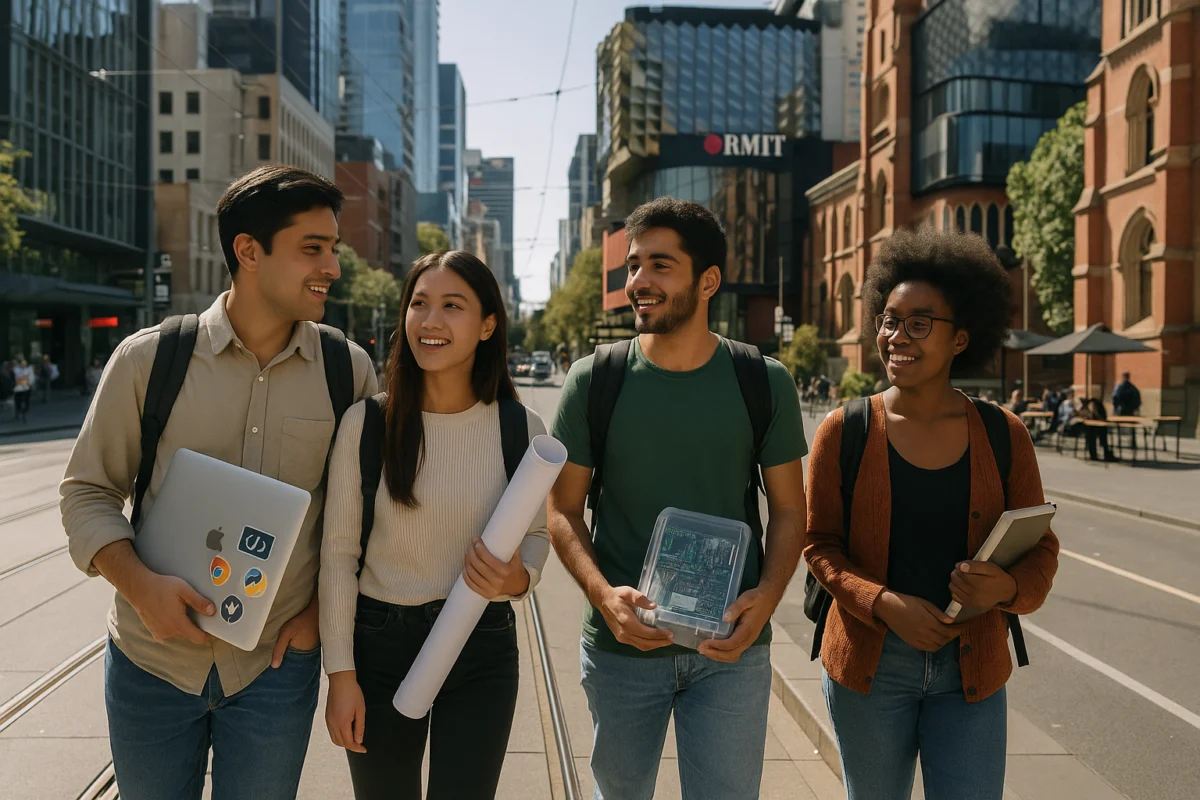
RMIT University has a very specific kind of appeal. It is not the classic isolated campus experience that many students imagine when they think of university in Australia. Instead, it feels woven into central Melbourne itself. For students interested in engineering, IT, design-led problem solving, and industry-connected learning, that urban setup is a big part of the attraction. You are not just studying in a university campus; you are studying in the middle of one of Australia’s busiest student cities, surrounded by offices, startups, public transport, cafés, and creative spaces.
That everyday environment shapes the student experience in noticeable ways. RMIT tends to suit students who like practical learning, independent thinking, project work, and a more career-aware university culture. It is especially well known for courses that connect academic learning with real-world applications, which is why engineering and technology students often keep it high on their shortlist.
Quick facts students usually look for
- Location: Melbourne, Victoria, Australia
- Main campuses for many students: City Campus, Bundoora Campus, Brunswick Campus
- Known for: Applied learning, industry collaboration, technology, engineering, design, business
- Academic calendar: Mainly Semester 1 and Semester 2, with some programs offering flexible or midyear entry
- Student mix: Large international student population and a very urban, multicultural atmosphere
- Official website: RMIT University
What makes RMIT stand out academically
One of the clearest things students notice at RMIT is that many courses are structured around doing rather than only listening. In engineering and IT, that often means labs, software tools, prototypes, workshops, code-based assignments, group design tasks, and capstone projects that ask students to build something usable or solve something practical.
RMIT has built much of its reputation around applied education. That does not mean theory is ignored. Students still deal with mathematics, systems thinking, technical concepts, programming logic, data structures, electronics, networks, mechanics, and formal assessments. But the university’s style often pushes students to connect these ideas with actual outputs. Instead of ending at classroom understanding, many units expect students to turn knowledge into reports, models, devices, presentations, software demos, or team-based solutions.
For students who learn best by making, testing, troubleshooting, and presenting, this can be a strong fit. For students who prefer highly guided learning with fewer collaborative expectations, the adjustment can be harder.
Engineering and IT education at RMIT
RMIT is particularly attractive to students looking at engineering and computing because the teaching style tends to align well with industry habits. In many courses, students are not just preparing for exams. They are also learning how to work in teams, document technical work, manage deadlines, use professional software, and communicate project outcomes clearly.
Popular study areas
- Computer science and software engineering
- Information technology and data-focused programs
- Cyber security and network-oriented fields
- Mechanical, civil, electrical, and aerospace engineering
- Mechatronics, robotics, and embedded systems-related pathways
What helps RMIT in this space is Melbourne’s broader ecosystem. Students are in a city with major engineering firms, construction companies, transport infrastructure projects, finance and consulting employers, healthcare technology groups, and a growing digital sector. That does not automatically guarantee a job, but it does create more visible pathways for internships, part-time technical roles, graduate programs, networking events, and industry panels.
Students interested in current tech skill areas also tend to explore complementary learning outside formal coursework. For example, some build extra capability through full stack development learning, AI & machine learning programs, or cloud computing skills that strengthen portfolios alongside university study.
The campus atmosphere feels different from a traditional university
RMIT’s City Campus is one of the biggest reasons students either love the university or take time to adapt to it. It is active, central, busy, and spread through the Melbourne CBD rather than enclosed in a quiet suburban environment. You move between academic buildings, laneways, tram stops, food spots, libraries, and public spaces with the city constantly around you.
For some students, this feels energizing and modern. There is always movement, and you are close to everything. For others, especially those expecting a classic green campus with all activities in one contained space, the city setup can feel less intimate at first.
Bundoora offers a more spacious environment and is relevant for many engineering and science students, while Brunswick has its own identity connected to creative and technical disciplines. Across campuses, the overall feeling is practical and metropolitan rather than ceremonial.
Academic structure, intakes, and exam timelines
RMIT generally follows the Australian semester model, although some courses and postgraduate pathways have additional flexibility. For most undergraduate students, the main study periods look like this:
- Semester 1: Usually begins in late February or early March and runs through June
- Semester 2: Usually begins in July and runs through October or November
- Midyear intake: Available for selected programs, often opening another entry point in July
- Orientation: Typically held before each main semester
Assessment style varies by school and program, but engineering and IT students commonly experience a mix of:
- weekly or fortnightly lab work
- coding assignments or technical problem sets
- quizzes and online tests
- design reports or group presentations
- mid-semester assessments around April or September
- final exams or project submissions in June and October-November
One useful thing to know is that not every unit ends with a heavy written final exam. Some technical subjects do, but others are assessed through a final project, demonstration, portfolio, or practical submission. That can be refreshing for students who prefer applied work, although it also means the pressure is spread across the semester rather than saved for one exam period.
Admission timelines, entry requirements, and international application details can be checked through the university’s official study portal and admissions pages, which are usually the most reliable source for current deadlines and program-specific criteria: RMIT international admissions.
How learning feels in practice
RMIT is often at its best when students are working on things that feel real. In engineering, this can mean labs, prototypes, simulation tools, testing, CAD-based workflows, or design-build-report cycles. In IT, it may involve databases, software development tasks, UI work, security concepts, networking exercises, system design, or collaborative coding environments.
Project-based learning is not just a brochure phrase here. Many students talk about long assignments that require planning over several weeks, not just overnight memorization. Teamwork is common, and so is the challenge of coordinating with classmates from different cultural and academic backgrounds. That reflects actual workplace conditions, but it can also be one of the harder parts of the experience.
Students who want to deepen technical specializations often add portfolio-style work in areas such as cybersecurity career preparation or data-driven tools outside class, especially when aiming for competitive graduate roles.
Common features of the learning culture
- Assignments that simulate practical workflows
- Capstone subjects tied to problem solving and presentation
- A stronger expectation of self-management than many students expect initially
- Frequent use of digital learning systems, software platforms, and technical tools
- Peer collaboration that can be rewarding but demanding
Industry exposure and career preparation
RMIT’s reputation for industry connection is one of the main reasons students choose it, especially in applied fields. The university has a long-standing focus on work-integrated learning, employer engagement, practical projects, and career-oriented teaching. In engineering and IT, this usually shows up through industry speakers, project collaborations, networking events, career fairs, employer presentations, and final-year experiences that push students to think beyond grades.
It is important to be realistic, though. In Australia, placements and internships are not always automatic or centrally assigned in the way some students from other education systems expect. Opportunities exist, but students often need to be proactive. The strongest outcomes usually go to those who combine academics with side projects, communication skills, LinkedIn activity, technical clubs, and early application habits.
RMIT helps by giving students access to career support, resume guidance, workshops, and employability-focused services. Melbourne also gives students more chances to attend startup events, tech meetups, hackathons, engineering conferences, and employer sessions. For IT students in particular, building a GitHub portfolio, participating in coding events, and showing project work can matter as much as classroom scores in some hiring contexts.
Career pathways students commonly target
- Software development and application engineering
- Data analytics and business intelligence
- Cloud and infrastructure roles
- Cyber security and systems support
- Civil, mechanical, electrical, and manufacturing engineering positions
- Graduate programs in consulting, transport, energy, and technology firms
International student life at RMIT
RMIT is widely considered international-student friendly, mainly because Melbourne itself is one of the most multicultural student cities in the region. On campus, hearing multiple languages in one building is normal. Students from Southeast Asia, China, South Asia, the Middle East, Latin America, Europe, and Africa are all part of the everyday campus mix.
That diversity makes group work, social life, and classroom discussion more globally shaped than at many smaller institutions. It also means new international students usually do not feel like outsiders for long. There are student associations, cultural societies, peer networks, orientation activities, and support services that help with transition.
What international students often notice quickly, however, is that life at RMIT requires independence. You manage your own time, transport, part-time work balance, and academic planning. Professors and tutors are available, but nobody will constantly supervise your routine. For many students, that is empowering. For others, it can feel overwhelming in the first semester.
Student lifestyle in Melbourne
Student life at RMIT is closely linked to Melbourne city life. That means the experience extends beyond lecture rooms. Students spend time in libraries, coworking-style study spaces, cafés, public gardens, food courts, nearby markets, and tram-connected neighborhoods. Weekdays can feel fast-paced, especially if you are balancing classes, commute time, and part-time work.
There is also a strong extracurricular side. Students often join clubs related to coding, engineering competitions, gaming, entrepreneurship, robotics, cultural communities, sport, media, and volunteering. You may not get a single unified campus bubble, but you do get a lot of freedom to shape your own routine.
What daily life can realistically involve
- Morning lectures followed by city-based commuting or part-time work
- Long lab sessions and group meetings during assessment weeks
- Using libraries or collaborative study areas in the evening
- Weekend project work, especially in technical courses
- Exploring Melbourne’s food, arts, sports, and student neighborhoods
Accommodation and living realities
One of the biggest practical issues for students is cost. Melbourne is attractive, but it is not cheap. Students living close to the CBD often pay more for convenience. Many choose shared apartments or student accommodation in areas with tram or train access, then commute to campus. Popular student zones include Carlton, North Melbourne, Brunswick, Kensington, and suburbs connected well to the city.
The good side is that public transport is useful and daily essentials are easy to access. The harder side is budgeting. International students especially need to prepare for rent, groceries, transport, mobile bills, and course-related expenses such as software, equipment, or project materials.
Common challenges students mention
RMIT offers a lot, but it is not effortless. Students who struggle usually do so because they underestimate how independent the system is. Missing early assessments, falling behind in labs, or not contributing properly in group work can quickly affect results.
- Workload spread: Many units have continuous assessment, so pressure builds across the semester.
- Group dynamics: Team projects can be very useful, but not always smooth.
- Urban distractions: City life is exciting, but it can also affect focus.
- Cost of living: Budget management is a real part of the student experience.
- Career competition: Good opportunities exist, but students need initiative.
That said, students who stay organized, ask for help early, and build practical evidence of their skills usually find RMIT rewarding. The environment tends to favor people who can combine technical learning with initiative.
Who is likely to do well here
RMIT is a strong option for students who want an applied, city-based university experience and are comfortable taking ownership of their progress. It works especially well for engineering and IT students who want regular project work, access to industry-facing opportunities, and a campus culture that feels connected to real professional environments.
If you want a university where practical learning matters, where Melbourne itself becomes part of your education, and where your portfolio can grow through both coursework and outside exposure, RMIT is easy to understand as a serious contender. It may not feel as traditional as some older universities, but for many students, that is exactly the point. The experience is modern, demanding, and closely tied to the kind of working world they are preparing to enter.
For students willing to be proactive, collaborative, and career-aware from the start, RMIT can become more than a degree destination. It can be the place where classroom knowledge starts looking a lot more like real professional capability.


 Views Today : 166
 Views Yesterday : 253
 Your IP Address : 217.76.57.9