
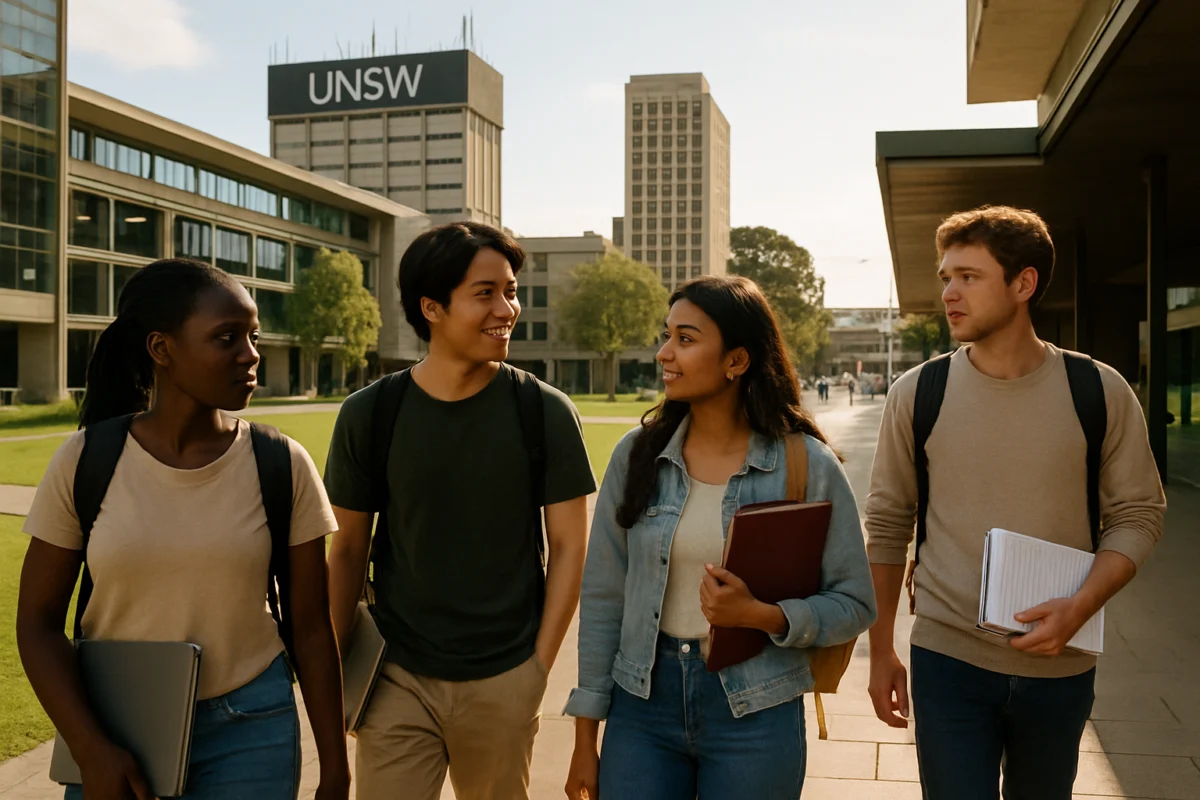
UNSW Sydney is one of those universities that often comes up when students talk about strong engineering, computing, and research-led study in Australia. What makes it stand out is not just the reputation, but the way the campus experience feels built around practical learning, fast-paced terms, and a clear connection to industry. For students who want a university that is academically serious but still socially active and internationally friendly, UNSW is usually high on the shortlist.
Set in Kensington, close to the city and not far from Sydney’s eastern beaches, the university has a location that feels both urban and student-friendly. You get the energy of a major global city without being stuck in a purely commercial district. That matters more than people think, especially when you are balancing lectures, labs, part-time work, group projects, and the everyday reality of student life.
Quick facts students usually want first
- Main campus: Kensington, Sydney
- Study model: trimester system with three main teaching terms
- Strong areas: engineering, computer science, business, data-focused study, architecture, and science
- Student mix: highly international, with a large number of local and overseas students
- Style of learning: theory plus labs, tutorials, team projects, and independent work
UNSW has long been known as a university with strong academic ambition, and that shows up in both course design and student expectations. It is also regularly placed among the world’s leading universities in global rankings, which helps explain why it attracts applicants from across Asia, Europe, the Middle East, and North America. If you want to check study pathways and course-specific entry details, the university’s own official study page is the best starting point.
Campus atmosphere in Kensington
The first thing many students notice about UNSW Sydney is that it feels active without being chaotic. The Kensington campus has a purpose-built academic mood, with modern buildings, open spaces, lecture halls, engineering labs, libraries, food outlets, and study corners spread across the site. It is not a compact one-building university where everything happens in one corridor. Instead, it feels like a real academic neighbourhood that students learn to navigate quickly.
The transport situation helps a lot. The light rail, buses, and walking routes make it relatively easy to reach campus from inner Sydney, nearby suburbs, or student housing areas such as Kingsford, Randwick, and Kensington itself. Many students like that they can live near campus without feeling too isolated from the rest of the city. Coogee, Maroubra, and the CBD are all part of the wider student lifestyle in a way that adds variety to the week.
There is also a pleasant contrast in the area: serious academic buildings during the day, then beaches, cafes, groceries, and a busy urban rhythm once classes end. For international students, that balance can be comforting. It gives them a campus that feels safe and structured, but still very much connected to Sydney’s wider culture.
How the academic rhythm works
UNSW uses a trimester system rather than the more traditional two-semester model. That means the year moves in a faster and more segmented way, and students need to stay organised from the start. The major teaching periods are usually T1, T2, and T3, with T1 beginning around late February, T2 around late June, and T3 around September. There are also breaks in between, plus occasional summer study options.
This system is one of the biggest things students should understand before joining. The pace is efficient, but it can feel compressed if you are used to longer semesters. Lectures, assignments, quizzes, lab submissions, and revision often move quickly, so students who keep falling behind can feel the pressure sooner than they expect. On the other hand, the fast rhythm keeps the year moving and gives students more opportunities to begin new subjects without waiting too long.
The university publishes important dates and key academic information on its official key dates page, which is worth checking before planning travel, work shifts, or exam preparation.
What a typical term feels like
- Weeks 1-2: orientation, enrolment adjustments, and early content setup
- Weeks 3-6: tutorials, lab work, smaller assessments, and group formation
- Mid-term period: quizzes, project check-ins, and first major submissions
- Final weeks: heavier assignments, revision, and preparation for exams or final presentations
- End of term: exam period, project demos, and submission deadlines
For many subjects, especially in engineering and computer science, the work is spread across the term rather than saved for one final exam. That is good news for students who like steady progress, but it also means the workload is continuous. Missing one week of tutorials can be more painful than it looks on paper, particularly in technical subjects where each topic builds on the previous one.
Popular programs and academic strengths
UNSW is particularly well known for technical and professional degrees, although it offers a broad range of study options. Students who want a career-focused environment often look here because the teaching culture tends to favour applied knowledge, not just theory for theory’s sake.
- Computer Science and Software Engineering
- Electrical, Mechanical, Civil, and Renewable Energy-related Engineering
- Data Science and Analytics
- Cybersecurity and Information Systems
- Business, Finance, and Actuarial Study
- Architecture, Design, and Built Environment programs
Engineering and computing students usually find that the university’s reputation comes from depth as much as breadth. Courses tend to be structured around problem-solving, lab work, and project outcomes. That makes the environment appealing to students who want to graduate with practical confidence rather than only classroom familiarity.
If you are comparing how to strengthen your profile outside the classroom, it is common to pair study with portfolio-building activities such as full stack development learning or more focused technical practice that mirrors the pace of university projects. Students in analytics-heavy courses may also benefit from extra data analytics training when they want to sharpen employability alongside their degree.
Student life beyond lectures
UNSW has a busy student culture, but it is not the kind of university where every social moment feels loud or forced. Instead, the atmosphere is built around clubs, events, societies, competition teams, and study groups that naturally overlap with academic life. Students who join early often settle in faster because they meet people in low-pressure settings instead of waiting for friendships to appear in class alone.
There is a strong mix of local and international students, which makes the campus feel culturally varied. On one side, you might see people rushing from labs with laptops and lab coats. On another, you will find club stalls, cultural events, sports sign-ups, and casual meetups happening around the same afternoon. The university also benefits from Sydney’s multicultural character, so students rarely feel like they are in a single-track academic bubble.
Accommodation is a major part of the experience, especially for new arrivals. Some students prefer university-managed housing or nearby residences because it reduces commute stress, while others choose shared apartments in surrounding suburbs to save money and live with friends. Sydney is not a cheap city, so students often become budgeting experts quickly. That reality is part of the UNSW experience just as much as lectures and tutorials are.
What tends to make student life feel balanced
- Clubs and societies that make it easier to meet people outside class
- Study spaces and libraries that support long project sessions
- Cafes and food options for days when students stay on campus for hours
- Sports, cultural groups, and volunteering opportunities
- Close access to beach suburbs and the city for weekend breaks
Practical learning and industry exposure
One of the strongest reasons students choose UNSW is the practical learning culture. This is especially visible in engineering, computing, and design-related programs, where labs, team assignments, prototypes, and presentations are a normal part of the degree. The idea is not just to memorise concepts, but to use them in situations that feel close to professional work.
Students often talk about group projects as both the best and most challenging part of the university experience. Group work can be frustrating when schedules clash or when team members contribute unevenly, but it also teaches real-world collaboration. Deadlines, version control, peer communication, documentation, and presentation skills become everyday habits. That kind of training matters when students later move into graduate roles or technical jobs.
In many programs, industry exposure comes through capstone projects, guest lectures, recruitment events, career fairs, student competitions, and networking sessions. Students interested in technical careers often spend time building GitHub portfolios, refining resumes, and practising interview skills. In that sense, UNSW supports the academic side of employability, but students still need to take initiative themselves.
For students who want to extend that learning beyond the syllabus, areas such as AI & machine learning programs, cloud computing skills, and even specialised paths like cybersecurity can line up well with the university’s technical environment. Many students also enjoy working on cybersecurity career preparation or related hands-on projects when they want a stronger portfolio before graduation.
Admissions and entry structure
Admission at UNSW depends on the level of study and the course you choose. Undergraduate applicants are usually assessed through school results, recognised qualifications, subject prerequisites, and English language requirements. Postgraduate applicants generally need a relevant bachelor’s degree, and in some programs, work experience or additional background knowledge can matter as well.
For international students, the admissions process feels detailed but manageable if handled early. Course pages usually spell out the exact academic thresholds, prerequisite subjects, and language scores. That said, students should not assume that all programs follow the same pattern. Engineering, business, architecture, and computing can each have different expectations, especially when subject depth is important.
Applications are typically submitted well before the intended intake, and it is wise to plan around visa processing, document checks, and accommodation searches. The trimester structure means students may begin in more than one main intake across the year, but applicants should always confirm the exact course availability rather than assuming every degree starts in every term.
Career support and graduate opportunities
UNSW’s career reputation is a major reason students apply in the first place. Sydney is a practical city for job searching because it has a dense concentration of employers in finance, consulting, technology, engineering, construction, and research. That location gives students a real advantage, not because jobs are automatic, but because industry access is genuinely easier than in more isolated university settings.
The university’s career ecosystem usually includes employer presentations, resume workshops, interview practice, networking events, and student-led opportunities that connect study with professional life. For engineering and computing students, the most valuable outcomes often come from combining strong coursework with project work, personal initiative, and external opportunities. Many graduates also progress into postgraduate research or specialist study, particularly in fields where technical depth is rewarded.
It is worth saying clearly that UNSW does not function like a guaranteed placement factory. Students still need to compete for opportunities, and the strongest candidates tend to be the ones who build skills steadily rather than waiting until the final year. What the university does well is create an environment where career preparation feels normal from early on, instead of being treated as an afterthought.
What international students usually notice
International students often describe UNSW as welcoming but demanding. The welcome part comes from the large overseas community, the multicultural city, and the fact that many administrative systems are designed with global students in mind. The demanding part comes from the academic pace and the expectation that students work independently from the start.
Many students notice that tutorials are important here. It is easy to think of lectures as the main event, but tutorials and labs often make the real difference in understanding. Students who ask questions, use office hours, and stay in touch with tutors usually settle in faster. This is especially helpful for those adjusting to Australian academic writing, participation style, or technical assessment formats.
Language and communication can also be a subtle adjustment. Even students with good English scores may need time to get used to the rhythm of fast lectures, informal discussion in tutorials, and assignment expectations that assume a degree of independence. The good news is that the university atmosphere rewards persistence. Once students learn the system, the workload becomes easier to manage.
Common challenges students should expect
No honest review of UNSW Sydney should skip the harder parts. The biggest challenge for many students is the fast academic pace. A trimester system is efficient, but it can feel intense if you are the kind of student who likes long breathing room between assessments. You need a good calendar, a clear weekly routine, and the discipline to handle work early instead of waiting for the final week.
Cost of living is another real issue, especially in Sydney. Rent, transport, groceries, and social spending can add up quickly. Students often have to think carefully about where they live and how often they travel. Shared housing and budgeting are part of the practical reality, and students who plan early usually cope better.
Group work can also become stressful when team roles are uneven. That is not unique to UNSW, but it is a common part of the student experience in technical courses. Still, many students find that the frustration is worth it because the projects push them toward skills that matter in graduate roles: collaboration, communication, problem-solving, and deadline management.
A final student takeaway
UNSW Sydney is a strong choice for students who want a university experience that feels ambitious, practical, and connected to industry. It is especially appealing for engineering and computer science students, but the wider campus culture also suits anyone who values a serious academic environment with real city access, active student groups, and strong career awareness. The workload is real, the pace is quick, and the city can be expensive, but the payoff is a university life that pushes students to grow steadily and graduate with confidence.
For students who are ready to stay organised, take initiative, and make use of the many opportunities around them, UNSW can feel less like a place to simply attend classes and more like a place to build a future.


 Views Today : 199
 Views Yesterday : 253
 Your IP Address : 216.73.216.174