
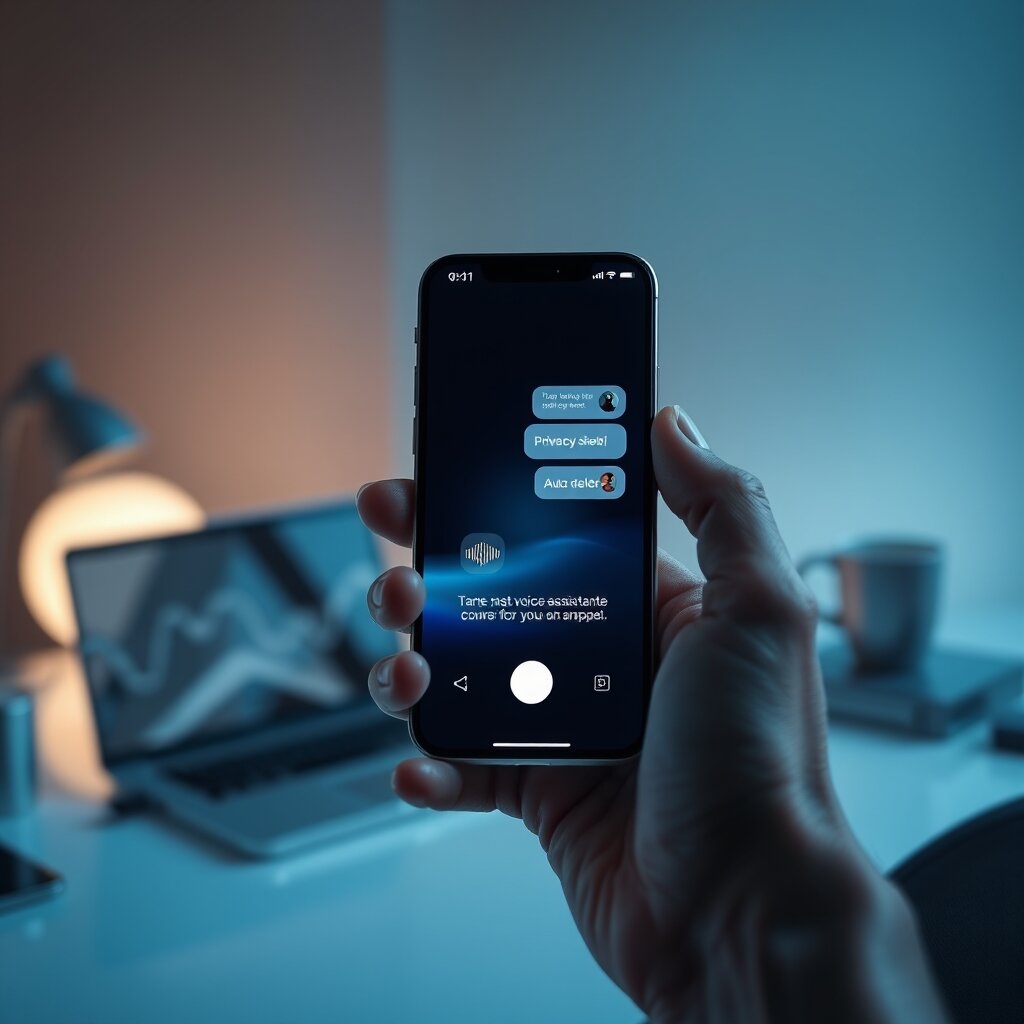
Apple’s next Siri may put privacy at the center with features like auto-deleting chats, on-device AI, and tighter data controls. Here’s why that matters for users, students, and developers. #siri #appleai #dataprivacy #voiceassistant #aiprivacy #consumertech
For years, voice assistants have promised convenience: hands-free reminders, quick searches, smart home controls, and natural conversations with devices that seem to understand us. But as AI assistants become more capable, they also become more personal. They process our routines, preferences, messages, search habits, and increasingly, our private questions.
That is why reports that Apple’s Siri revamp could include auto-deleting chats are more significant than they may first appear. This is not just a small feature update. It points to a broader shift in how AI assistants may be designed in the years ahead: less focused on collecting endless user history, and more focused on giving people meaningful control over their digital footprint.
If Apple makes privacy a major theme in the next version of Siri, it could influence not only consumers, but also developers, students, cybersecurity learners, and the wider AI industry. The move would fit Apple’s long-standing public position that privacy should be built into products rather than added later. In the age of generative AI, that principle is becoming much harder to maintain—and much more important.
Why Auto-Deleting Chats Matters in the AI Era
Auto-deleting chats may sound like a simple housekeeping tool, but in AI systems, conversation history can be extremely sensitive. Unlike traditional search engines, AI assistants often handle more personal requests. A user may ask about finances, health concerns, travel plans, work tasks, passwords, family schedules, or study goals. Even when conversations seem harmless, a long record of prompts can reveal patterns that feel deeply intrusive when stored indefinitely.
An auto-delete option changes that relationship. Instead of assuming that every query should be retained, it creates a model where data can expire by design. That approach has several practical advantages:
- Reduced long-term exposure: If chat history disappears automatically, there is less personal information sitting in storage over time.
- Lower breach impact: In any digital system, less retained data often means less risk if something is compromised.
- Greater user trust: People are more likely to use AI tools for meaningful tasks when they feel their interactions are not being archived forever.
- Cleaner product boundaries: Companies can define more clearly what is used temporarily for assistance versus what is kept for personalization.
For users, this could make Siri feel less like a data-hungry assistant and more like a private utility. For Apple, it could become a key differentiator in an AI market where privacy claims are often vague.
Apple’s Privacy Strategy and the Bigger Siri Reset
Apple has been careful about how it approaches AI compared with competitors that moved aggressively into cloud-based chatbots and large-scale assistant experiences. While rivals focused on speed and feature breadth, Apple appeared to take a slower route, emphasizing hardware integration, on-device processing, and privacy messaging.
The company’s official privacy framework has long highlighted ideas such as data minimization, transparency, and user control. A refreshed Siri gives Apple a chance to turn those principles into visible features that ordinary users can understand.
That matters because privacy in AI is often discussed in technical or legal terms. Most people do not read data policy documents, compare retention schedules, or examine where inference happens. But they do understand clear product behaviors such as:
- Chats disappear after a selected period
- Requests are processed on device when possible
- Users can easily review and delete history
- Sensitive queries are not used for broad training by default
If Siri adopts these kinds of controls, Apple would be converting abstract privacy promises into practical design choices. That is a strong message in a market where AI products increasingly compete on trust as much as intelligence.
What an Updated Siri Could Look Like
Although the full feature set remains to be seen, a privacy-first Siri revamp would likely go beyond auto-deleting chats alone. To make the experience coherent, Apple may combine chat controls with deeper architectural and interface changes.
1. Smarter On-Device Processing
One of Apple’s biggest advantages is its hardware ecosystem. Chips in iPhones, iPads, and Macs are now powerful enough to run more AI tasks locally. On-device processing allows certain requests to be handled without sending as much information to external servers.
This matters for privacy because local execution reduces exposure. It can also improve speed, especially for common tasks like summarizing text, setting reminders, rewriting messages, or responding to app-level requests.
Students and developers interested in this direction can see how the AI industry is increasingly blending edge computing with practical machine learning workflows. Those exploring the field can build foundational skills through programs such as the AI & Machine Learning internship, where model behavior, data handling, and applied AI concepts become much easier to understand in real-world contexts.
2. Granular Chat History Controls
A privacy-forward Siri would benefit from flexible retention settings. Instead of a basic on or off switch, Apple could offer options such as:
- Delete after 24 hours
- Delete after 7 days
- Delete after 30 days
- Never save certain conversation types
- Manually clear all history at any time
This kind of granularity would allow users to balance convenience and privacy according to their needs. Someone who wants continuity for productivity tasks may keep short-term context, while another user may choose minimal retention across the board.
3. Better Transparency Around Data Use
One of the biggest frustrations with AI assistants is that users often do not know what happens after they ask a question. A redesigned Siri could address this with simple disclosures, showing whether a request was handled locally, whether it was sent securely for cloud processing, and whether any record is kept.
That kind of transparency would not just improve trust. It would also raise the standard for AI usability. Privacy is not only a policy issue; it is a product design issue.
4. Context Without Permanent Memory
Modern AI assistants are expected to remember context across a conversation. The challenge is doing this without creating a permanent archive of every interaction. Apple could explore temporary session memory, where Siri remembers what matters during a current interaction but clears much of it afterward unless the user explicitly saves something.
This could be especially useful in productivity scenarios. A user might ask Siri to help summarize notes, draft a message, and schedule a follow-up, all within one flow, while still knowing that the temporary context will not linger endlessly.
Why Privacy Is Becoming a Competitive Feature
There was a time when privacy was treated mainly as a compliance box or a niche selling point. That is changing quickly. In the AI era, privacy has become central to product adoption.
People are testing AI assistants with real work, personal planning, and sensitive information. Businesses are asking employees to use AI tools carefully. Universities are debating student AI usage and data protection. Parents are paying closer attention to how digital tools handle minors’ information. In this environment, products that cannot explain data retention clearly may face resistance.
Apple likely understands that the next generation of AI users will not evaluate assistants only on creativity or speed. They will also ask:
- How much of my information is stored?
- Can I control what is remembered?
- Is my data used to improve systems without clear consent?
- Can I trust this tool for everyday personal tasks?
These are no longer niche questions. They are becoming mainstream buying and usage decisions.
What Students and Young Professionals Should Pay Attention To
This development is especially relevant for students, fresh graduates, and early-career professionals who are growing up alongside AI-native tools. Many of them will rely on voice assistants and AI systems for note-taking, research help, scheduling, writing support, coding assistance, and career planning.
That convenience comes with responsibility. Understanding how AI systems store, process, and retain information is now part of digital literacy. It is not enough to know how to prompt a tool effectively; users also need to know when not to share confidential data and how to use privacy settings wisely.
Useful habits include:
- Reviewing chat retention or history settings before using an AI assistant heavily
- Avoiding unnecessary sharing of financial, medical, or institution-specific confidential details
- Understanding whether a tool processes data locally or in the cloud
- Deleting histories periodically if auto-delete is unavailable
- Using official documentation rather than assumptions about how a tool works
Apple’s Siri redesign could help make these habits easier by turning privacy protections into default product behaviors rather than buried settings.
Implications for Developers and Product Teams
For software teams, Apple’s privacy-first direction could become an influential benchmark. When a major platform company elevates data minimization in a consumer AI product, it changes user expectations everywhere else.
Developers building assistants, chatbots, productivity tools, and educational platforms may need to think more carefully about:
- Retention policies for prompts and responses
- Clear consent around training data usage
- Temporary versus persistent memory systems
- Auditability and deletion mechanisms
- User-facing explanations for data flow
This is particularly relevant in sectors like education, health, finance, and enterprise software, where trust and compliance intersect directly with product design.
Cybersecurity and privacy-aware development skills are becoming increasingly valuable across these domains. Learners who want to understand the security side of digital products can explore paths like the Cyber Security & Ethical Hacking internship, where concepts such as risk exposure, secure systems, and responsible data handling are highly relevant to modern AI platforms.
How Siri Fits Into the Broader Apple AI Vision
Siri has often felt like an underused asset in Apple’s ecosystem: widely available, deeply integrated, but sometimes less capable than users hoped. A serious revamp could reposition it as more than a voice command layer. It could become Apple’s central AI interface across iPhone, iPad, Mac, AirPods, Apple Watch, and possibly future devices.
For that strategy to work, Siri needs improvement in two areas at once:
- Capability: better understanding, more natural conversation, stronger app actions, and useful generative AI assistance
- Trust: clear privacy protections, sensible defaults, and transparent control over stored interactions
Apple appears uniquely motivated to connect these two ideas. While many competitors started with cloud-scale intelligence and later moved toward privacy guardrails, Apple has a chance to present privacy as part of the assistant itself.
The company’s broader AI messaging, including its Apple Intelligence initiative, suggests that personal AI on Apple devices will lean heavily on private processing and selective server use. Siri is the most visible place where those promises will be tested in everyday life.
The Limits and Trade-Offs of Privacy-First AI
Of course, privacy-focused AI design is not magic. There are trade-offs. Auto-deleting chats can reduce continuity. Limited retention may make long-term personalization weaker. On-device processing can face hardware constraints. Some advanced tasks may still require secure cloud infrastructure.
That means Apple’s challenge is not simply to store less data. It is to create a product that still feels smart, useful, and context-aware while keeping data exposure low. This is a difficult engineering and design problem.
But it is also an important one. The future of consumer AI may depend on whether companies can move beyond the false choice between intelligence and privacy. Users increasingly want both.
In practical terms, the most successful assistants will likely be those that:
- Keep sensitive data local whenever possible
- Use short-lived context intelligently
- Allow selective memory instead of all-or-nothing retention
- Explain data behavior in plain language
- Offer simple deletion and account controls
If Apple gets that balance right, the Siri update could become more than a product refresh. It could become a case study in responsible AI design.
Why This Shift Matters Beyond Apple
Even people who do not use Siri should pay attention to this move. Major consumer platforms often shape norms across the entire tech ecosystem. When one company makes privacy visible in AI interactions, competitors, regulators, schools, and app developers all take notice.
That ripple effect can influence how future assistants are built, how institutions evaluate AI tools, and how users think about digital trust. It can also push the industry toward a more mature conversation: not just what AI can do, but what it should remember, for how long, and under whose control.
For learners and job seekers exploring the wider technology landscape, this is a reminder that AI skills are no longer just about models and prompts. They also include product ethics, privacy engineering, cybersecurity awareness, and user-centered design. Those interested in building career-ready technical skills across these domains can browse internship opportunities in emerging tech fields that connect AI, software, data, and security in practical ways.
If Siri’s next chapter truly includes auto-deleting chats and stronger privacy controls, Apple may be signaling something larger than a feature update. It may be showing that in the next phase of AI, the most trusted assistant could be the one that knows when to forget.
#siri #appleai #dataprivacy #voiceassistant #aiprivacy #consumertech


 Views Today : 40
 Views Yesterday : 204
 Your IP Address : 216.73.216.174